Hidden water found and mapped before any wall is opened - meters, thermal imaging and a reading-by-reading map of exactly where the water is and where it came from.
Moisture detection is the use of meters, thermal imaging and systematic readings to find, measure and map water hidden inside walls, floors and ceilings.
The visible stain is usually the smallest part of a water problem. Detection turns suspicion into a document: a moisture map with readings, a source identified, and drying targets a crew can be held to.
Moisture detection is the use of meters, thermal imaging and systematic readings to find, measure and map water hidden inside walls, floors and ceilings.
The three parts of this service answer three different questions. Moisture detection finds and measures the water. Leak detection traces it back to its source. Moisture mapping records the readings on a property plan, so the extent is documented rather than estimated. Detection itself does not dry or repair - it decides the scope of both, which is why every serious drying plan starts from a map.
We walk the affected areas and read surface moisture with meters at the visible damage - and beyond it, in a widening pattern. The survey establishes whether water travelled past what the eye can see.
Readings are recorded room by room on a property plan: wet, damp and dry zones, each with its numbers. The map is a deliverable document - part of your insurance record - and the drying plan's targeting sheet. A reading without a location is not a map.
Walls, ceilings and floors are scanned with an infrared camera. Wet areas appear as temperature patterns that point to hidden water paths - which the meters then verify. Imaging indicates; meters measure. That order never reverses.
The mapped pattern is followed back to its source - a supply line, a fixture, a roof path, a condensate line or a foundation entry. The identified source decides what happens first: a plumbing repair, a roof repair, or source control.
The map, readings and source finding are delivered as the job's documentation, and the map converts directly into drying targets - each wet material gets its dry-standard goal on the structural drying plan.
A stain that returns after surface drying means the cavity behind it is still wet. Detection decides the cavity's real extent before anything is opened.
Odor without a visible source: hidden wet material inside a wall, under a floor, or around the HVAC. This is the mold file's earliest chapter, written in readings.
A usage spike with no visible leak is a running hidden leak until the readings prove otherwise. Tracing is the answering action.
Post-event verification: the visible area is dry, and the question is what travelled. One detection visit sets the drying scope and runs the mold-prevention check together.
A moisture survey of kitchens, bathrooms, basements and the water heater area - older downtown and subdivision stock rewards the check before purchase or renovation, not after.
Three instruments do the work. Each is stated with its limit, because the limits are the expertise:
Pin meters measure moisture inside a material at pin depth - drywall, wood, framing. Pinless meters scan wide areas without holes, for survey work. The pair is one class in two forms: survey pinless first, verify with pins. A meter reads only where it is placed - which is why mapping, not spot checks, is the service.
The camera renders surface temperature differences as an image. Evaporating moisture cools surfaces, so wet paths show as patterns a trained reading can follow. The limit, at full strength: it is not X-ray vision and it cannot measure moisture content. Meter verification is mandatory.
Room humidity and temperature readings complete the picture - they set drying conditions and flag chronic humidity problems. The EPA's reference values apply: indoor humidity below 60 percent, ideally between 30 and 50 percent. A home can have no leak and still have a moisture problem.
They answer different questions, and a complete visit usually runs both - detection without source-tracing leaves the cause running, and tracing without mapping leaves the extent unknown.
| Question | Moisture Detection | Leak Detection |
|---|---|---|
| What it answers | Where the water is, and how much | Where the water is coming from |
| Tools | Meters, thermal imaging, moisture mapping | Tracing, source isolation, pattern analysis |
| Output | The moisture map and drying targets | The identified source and the repair decision |
A meter survey maps the readings, thermal imaging shows the wet pattern, and the pattern is traced to its source. Walls are opened only where readings prove water is inside - and only as far as the map requires.
The honest half of the answer: non-invasive methods locate and measure, and a small, targeted opening is sometimes the final verification. We state that plainly rather than promise it away, because a service that hides its limits will hide its readings too.
A single-room survey and map is completed in one visit; whole-home work and multi-source tracing take longer in proportion to the areas and sources involved. The deliverables leave with the visit - map, readings, source finding, drying targets - so the decisions that depend on them can be made the same day.
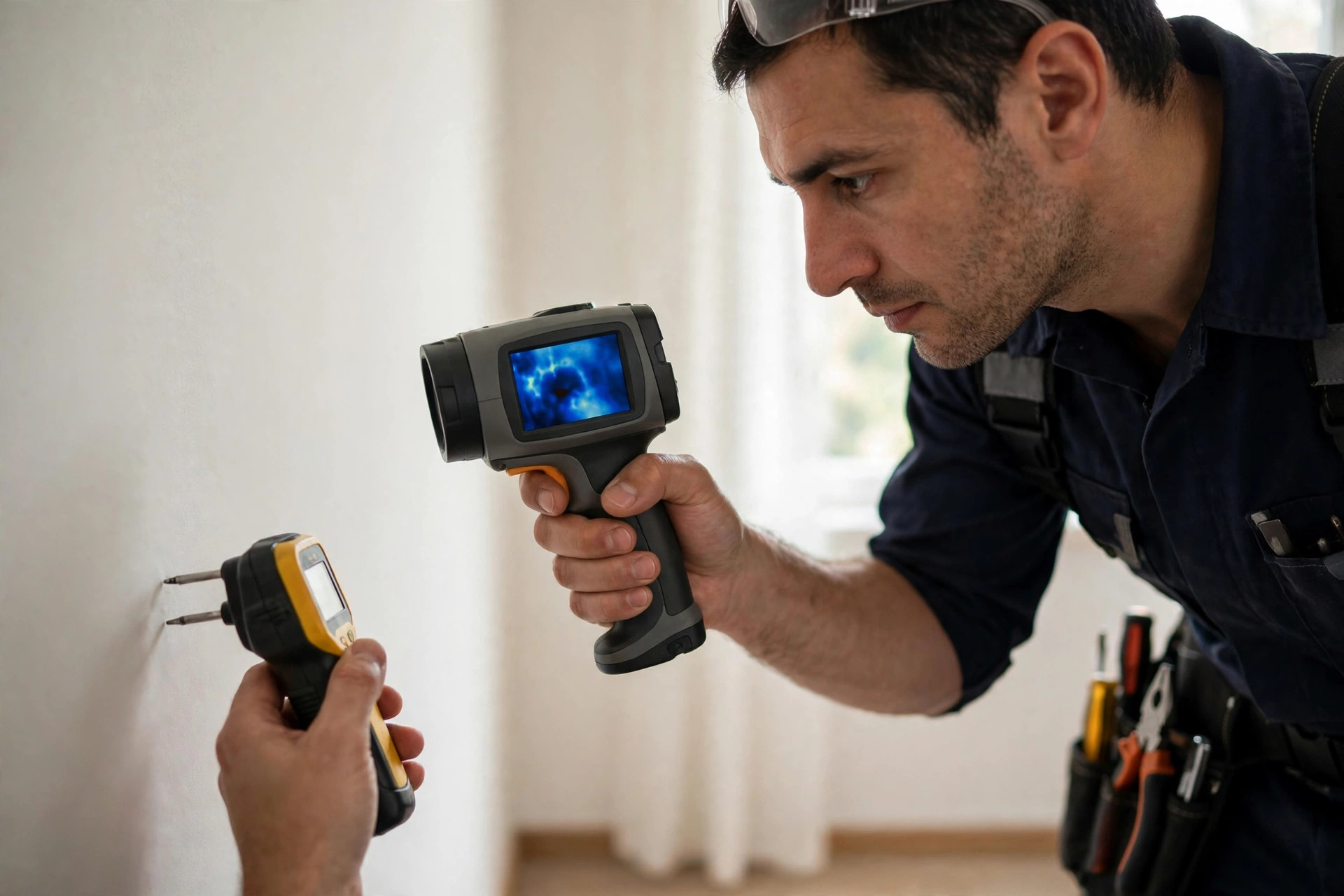
No. A thermal camera reads surface temperatures, not interiors. The useful truth is one step removed: because wet material cools by evaporation, hidden water changes the surface pattern in ways a trained reading can follow - and a meter can then verify. The myth version of imaging is easy to sell; the real version is the one that finds your leak.
A consumer meter can confirm a suspicion at one spot - a reading at a stain - and that has real value as a trigger to call. Its limits are this service's definition: no survey pattern, no map, no imaging, no source tracing. One reading cannot set a drying scope or document an insurance claim.
The survey, imaging and mapping stages are non-invasive. Pin meters leave pinholes smaller than a picture hook where they are used. Any targeted opening happens only after readings have proven water is inside, and only with the scope explained first - proven need, explained first, in that order.
24/7 emergency response, every day of the year
Local Buford team for Gwinnett and Hall counties
One team from mitigation to final restoration
Drying verified by moisture readings and moisture mapping
Documentation prepared for your insurance claim
Clear next steps and updates at every stage
Based in Buford (ZIPs 30515, 30518, 30519), serving Gwinnett and Hall counties. The full service-area treatment is on the homepage.
If your Buford home or business needs moisture detection, one call starts the work today - (470) 516-0618.